Mechanism geometry
Fold angles, travel, clearance and stress points are checked in the working dummy.

Paper engineering for premium publishing
For publishers, museums, cultural institutions, education teams and brands that need a dimensional book to open cleanly, move reliably and survive repeated handling. Every mechanism is proven before bulk production.



Movement is part of the message
An interactive edition succeeds when the paper mechanism supports the story without becoming fragile, difficult to assemble or inconsistent in bulk. Fold geometry, grain direction, board thickness, die-cut tolerance and adhesive placement all affect the reader's experience.
We turn an approved concept into a reproducible production system: first a structural dummy, then artwork and dielines, then a printed engineering sample, and only then controlled bulk assembly.
Interactive formats
The right mechanism follows the content, audience, handling frequency, page area, edition size and target cost—not novelty alone.

Layered V-folds, platforms and architectural structures that rise as the spread opens.
Discuss this structure →
Reveal windows and learning sequences engineered for repeat opening and clear registration.
Discuss this structure →
Guided movement, sliding layers and reveals with clearance tested before printing.
Discuss this structure →
Layered apertures and concertina structures that create controlled depth and viewing angle.
Discuss this structure →
360-degree paper constructions designed to work both as a reading object and a display piece.
Discuss this structure →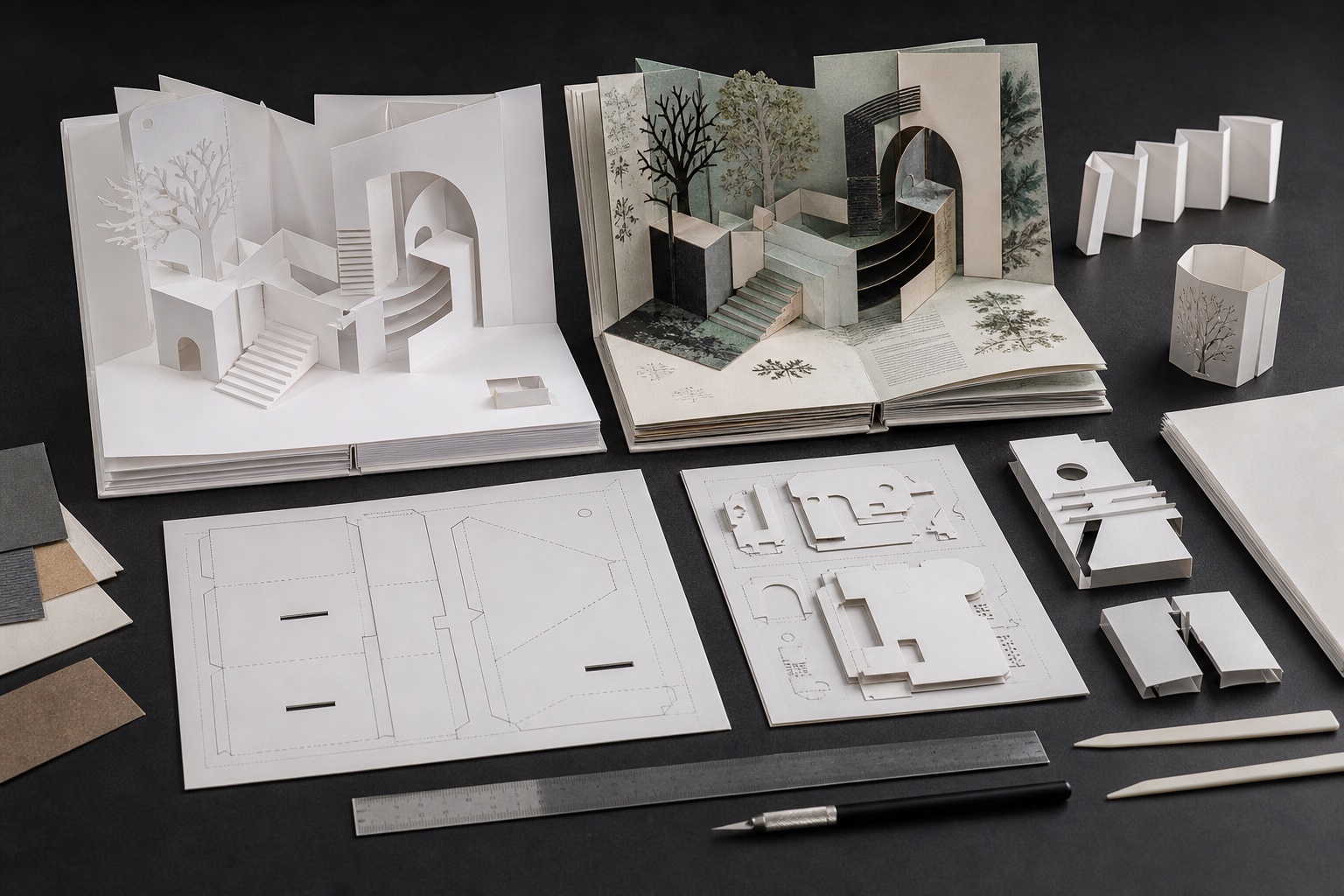
Mixed mechanisms, wheels and special structures developed through a working dummy and printed sample.
Discuss this structure →Specification framework
These are planning routes, not fixed promises. Final construction follows the approved dummy, artwork, paper behavior, safety requirements, quantity and destination.
Send your concept and specification →| Finished format | Custom portrait, landscape, square, shaped and display formats reviewed against opening angle and mechanism travel. |
|---|---|
| Mechanism types | V-fold, parallel fold, platform, floating layer, flap, pull-tab, slider, wheel, tunnel, carousel and approved combinations. |
| Paper & board | Coated, uncoated, specialty papers and paperboard selected for stiffness, fold endurance, print response and safe handling. |
| Binding | Casebound, board-book, concealed wire, accordion and special assemblies confirmed through a working prototype. |
| Surface options | Protective film, aqueous coating, foil, emboss, deboss, spot effects and approved specialty finishes compatible with folds and glue areas. |
| Prototype stages | White structural dummy, artwork/dieline review, printed engineering sample and signed production reference. |
| Quality checkpoints | Die-cut registration, crease quality, glue position, movement clearance, repeated-use function, page sequence and packing protection. |
| Commercial brief | Quantity tiers, destination, target launch, artwork status, intended age/use and required testing or documentation. |
Production control
The signed dummy, printed sample, dielines and written specification form the production reference.
Fold angles, travel, clearance and stress points are checked in the working dummy.
Stiffness, grain, scoring direction and surface behavior are matched to movement.
Cut registration, nick position, crease depth and waste removal are controlled by structure.
Adhesive zones, tabs, jigs and assembly sequence are defined to reduce variation.
Pages are opened, moved and checked for sticking, tearing, misalignment and incomplete travel.
Raised parts, delicate surfaces and presentation components are protected through packing.
Project path & lead-time control
Share concept, reference, intended use, size, quantity, destination and artwork status.
Build and approve a working white dummy with the required movement and opening.
Apply artwork to agreed dielines and produce the printed engineering sample.
Print, die-cut, crease, fold, glue and assemble against signed references.
Function-check, protect delicate elements, pack and coordinate shipment by destination.
Interactive book FAQ
We can review and production-engineer a supplied concept, reference or working idea, then help refine it into a testable structure. The design responsibility, scope and deliverables are agreed before prototype work begins.
A dummy reveals whether the mechanism opens, closes, clears the gutter, carries the artwork area and can be assembled consistently. A drawing alone cannot prove these points.
Send the concept, reference images or prototype, finished size, page sequence, artwork status, dielines if available, mechanism notes, quantity tiers, destination and target launch date.
The choice depends on fold endurance, stiffness, thickness, grain, coating, print requirement and the size of each moving element. Materials are confirmed through the prototype and sample route.
Yes, but the intended age, construction and market determine required materials, edge treatment, component design and testing documentation. Compliance is only represented when supported by the applicable verified records.
Quantity influences tooling, hand assembly, unit cost and inspection planning. Share realistic quantity tiers so we can compare an appropriate production route rather than assume one fixed minimum.
Lead time is confirmed after the mechanism, files, prototype route, printed sample, materials, assembly complexity, quantity, packing and destination are reviewed. It is not responsibly promised from the title alone.
Start with the mechanism
Send the concept, reference, size, page plan, quantity, destination and artwork status. We will identify the prototype and production decisions required before quotation.
Start an interactive book project